Brand Context as a Retrieved Dependency Not a Prompt Argument
Brand context works better as a shared dependency than scattered prompts.

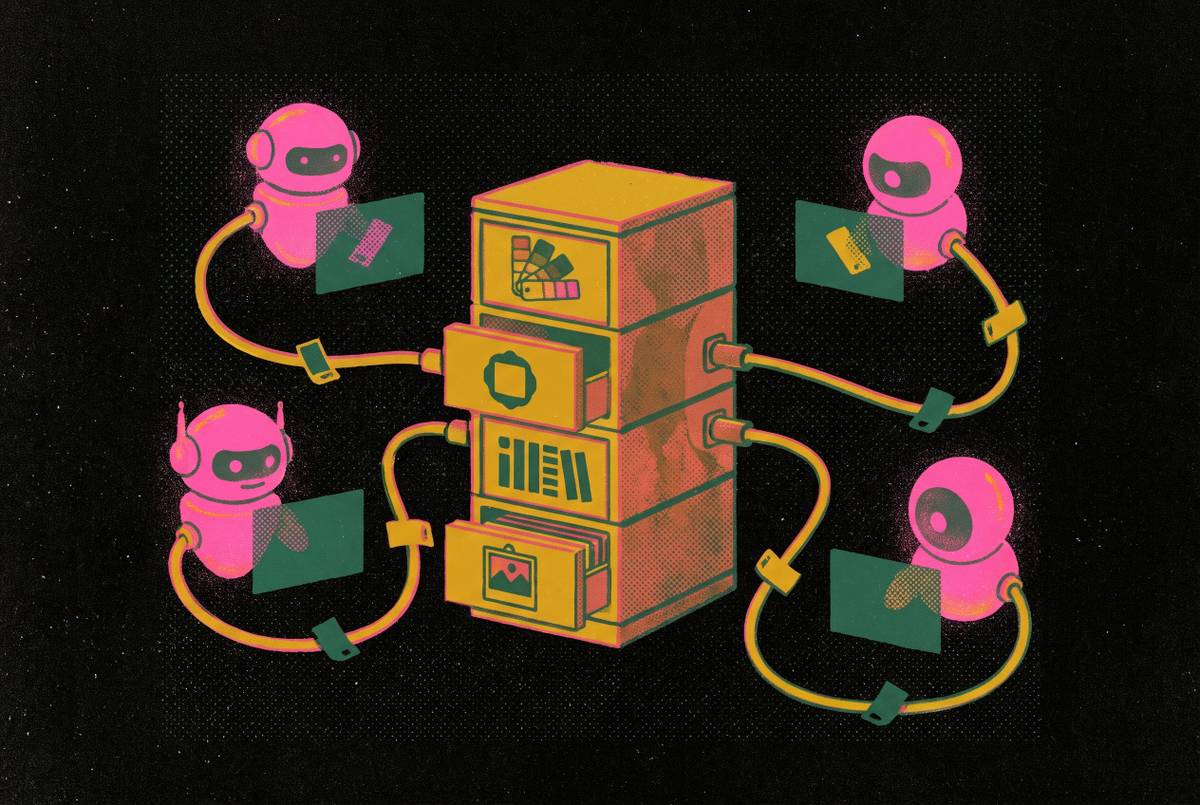
The brand layer for agents is a shared, versioned source of brand identity that agents retrieve at runtime. When brand context is a retrieved dependency, multiple agents can use the same guidelines, teams can update them in one place, and people have less to repeat in prompts. The architecture must connect generation and review to that same source.
Why brand context disappears between agent sessions
Consider a campaign with three agents working in parallel on copy, images, and channel formatting. Each receives an instruction to follow the brand voice, but none receives a shared definition of it. Each fills the gap with its own interpretation. The results can be competent and plausible while disagreeing about what the brand should sound or look like. Generic quality disguises the missing context, making drift harder to catch than an obvious error.
The gap widens as agents make successive decisions. An assistant responds to a request, while an agent makes a series of choices, using whatever context it has at each step. Brand knowledge can guide those choices only if it is part of that context. A prompt supplies it for a session, but does not establish a persistent source for new runs, parallel agents, or handoffs. When the brand changes, every prompt template that holds its identity needs its own update.
How software engineering already solved this problem with retrieved dependencies
Software dependency resolution provides a useful model for this separation. A dependency comes from a shared, versioned source, is resolved at build or runtime, and is available to the modules that need it. Each module does not argue for a library version in its own call signature. Brand context pasted into every prompt resembles a configuration value hardcoded into every function call. It can serve the immediate task while creating copies that become difficult to maintain together.
The architectural change is to move identity out of those copies and into a persistent, authenticated source. In this model, “resolved once” means establishing the authoritative context for a job. Different agents can retrieve it when they need to make choices, while still treating the same source as the authority. The shared source determines the brand, while the task determines which parts apply.
What MCP makes possible as a delivery mechanism for brand context
Anthropic’s Model Context Protocol announcement describes an open standard for secure, two-way connections between data sources and AI-powered tools. Developers expose data through MCP servers, and AI applications connect as MCP clients. This separates the source from the consuming application. For brand context, the server holds the queryable identity, while connected agents retrieve it at decision points.
In a multi-agent workflow, each agent can independently query the same server. MCP supports read and write capabilities, so the connection can also let agents return brand-relevant outputs to the system. The official MCP specification allows authorization through OAuth 2.1, so access to that context can be controlled. Authentication and access controls still belong to the implementation rather than following automatically from a connection. MCP supplies the delivery channel, but the brand knowledge behind it must be structured well enough to use.
Structuring brand identity so agents can actually retrieve and use it
A phrase such as “clean tech-forward” leaves an agent to translate an impression into production choices. A human-readable guide alone does not remove that interpretation. The payload needs a more exact structure. Design tokens provide the visual and structural layer by expressing standards as machine-consumable values with meaningful names. A token such as color.action.primary, rather than blue, identifies the value’s role, preserving intent when the palette changes. Centralized tokens let a single update reach the agents and workflows that read them.
A structured brand document, analogous to a brand.md file at the project root, supplies the wider identity layer. It covers identity, voice, color, typography, logo, and motion so that development agents configured to read it at session start have context before their first decision. A Voice Profile adds the behavioral layer through tone, vocabulary, sentence structure, exclusions, and annotated examples of actual brand language. Examples turn abstract rules into usable evidence. Together, these files link values, identity, and behavior, with each doing its own part of the work. The same principle favors component libraries over screenshots, structured content models over Word docs, and metadata and taxonomy over loose naming conventions.
What happens to AI-generated creative when brand context is missing at the production level
A branded object in generated video exposes the limits of text-only instruction. Its logo may change shape or spacing from frame to frame, even when the rest of the scene looks convincing. Professionals’ use of image-to-video anchoring rather than text-to-video supplies a visual reference at generation, reflecting the need for brand information that prose alone cannot adequately express. Missing context is therefore not just a copywriting problem, nor can every production defect be corrected by a more emphatic prompt.
Copy and images reveal the same gap in less conspicuous ways. When briefs, visuals, and AI drafts sit in separate tools, the context in the original brief may never reach the drafting agent or the person publishing its work. Image generation can quickly produce something that looks finished while missing the brand’s audience or quietly contradicting its positioning. That apparent completeness makes the remaining gap consequential. As creative volume grows, repeated omissions produce systematic drift across channels. Production needs the relevant brand artifact at the point of decision, whether that artifact defines language, visual identity, or a reference for motion.
How do multiple AI agents stay on brand from generation through review?
One agent retrieves the brand context and turns it into a brief for the task, which a creative studio agent uses to generate content. A channel-aware formatting agent then adapts the result for its destination. Each draws from the same source. The brief is the intermediate artifact that makes the shared identity usable for a particular assignment, scoping the relevant logo, type, colors, imagery, and voice rules without asking every downstream agent to reinterpret the full guidelines.
For copy, that brief brings the Voice Profile into drafting and channel adaptation. For images, it supplies the visual standards and imagery guidance against which the output will be judged. For video, a visual anchor gives generation a brand reference beyond a text description, but the result still needs to be checked. Review closes that remaining gap before publication. Finished work should be evaluated against the same brand source, with evidence for each check, so retrieval is not mistaken for correct application. When the source changes, subsequent briefs and reviews use the updated context without requiring manual edits across prompt templates.
Why agencies and multi-brand operators feel the absence of shared context most acutely
When a system handles several brands, it must be built to switch context between them. The relevant unit is one brand and one source of truth, covering its palette, font family, tone guidance, and AI-ready context together. A switch must retrieve the complete new identity. If an agent receives the new brand’s voice but retains another brand’s visual instructions, the workflow has not actually switched its dependency. Repeating brand instructions across every agent, task, and prompt makes this separation prohibitively difficult to maintain. One brand context server per brand, queryable over the same protocol, gives the workflow an explicit source to resolve.
Safety and compliance checks depend on that same separation. Color profile adherence, logo placement, prohibited language by market, regulatory claim restrictions, and tone-of-voice scoring must use the context that governed generation. Asset metadata is another retrieved dependency. It needs to travel through repurposing workflows with the asset, including asset type, approved markets, talent and IP rights expiry, territorial scope, product claim approvals by region, brand tier, cleared language variants, and campaign phase. Re-establishing those facts at each handoff recreates the original problem.
The quality of brand context delivered over MCP depends on how well the server describes its tools
Central retrieval solves persistence and propagation, but it does not make poor source material precise. A vague server can distribute ambiguity more consistently. An arxiv study of MCP tool descriptions from a large sample of servers found that 97.1% had at least one problem with the quality of their descriptions. The study found Unstated Limitations, Missing Usage Guidelines, and Opaque Parameters among the most common problems, and more than half also had an Unclear Purpose smell. The study looked at MCP tool descriptions in general without measuring how often brand context fails, but its finding shows a weakness that can affect how that context is delivered.
For a brand server, unclear tool descriptions leave agents uncertain about what to retrieve, which parameters to supply, or when the result applies. A useful connection therefore requires both a structured payload and clear descriptions of the tools that expose it. Semantic naming, explicit rules, and annotated examples serve retrieval as well as generation. The objection is to weak authoring. Prompt-based context suffers from the same ambiguity while also losing persistence and distributing maintenance across copies. Improving the shared source can improve every consumer, whereas improving one prompt leaves the other versions untouched.
What it means in practice to treat brand context as infrastructure
Teams need to make explicit decisions about where identity lives, how agents access it, and who keeps it current. A team should add the brand once from a website, brand guide, or uploaded files to establish the shared source. MCP-compatible agents can retrieve that context over MCP, while a product integration can draw from the same underlying context through a REST API. These are delivery choices around one authority.
That source should be versioned and updated centrally when the brand changes. Task-specific briefs should then be generated from its current context, covering the visual and voice rules relevant to the assignment. Before work ships, each check should use the shared brand standard and provide evidence that the output meets it. Every new agent, workflow, and channel can then begin with the current brand instead of inheriting whatever someone last pasted into a prompt.