Logo Fidelity in AI-Generated Composite Images
AI models treat logos like background scenery, drifting them subtly with each generation.

A composite image comes back from an AI generation tool and it looks finished. The lighting is right, the scene reads as intentional, the composition is clean, and then someone on the brand team looks at the logo in the corner and stops. Sometimes the blue is a shade warmer than it should be. Maybe the mark has drifted closer to the edge of the frame than the lockup allows. Maybe, if there's a wordmark involved, a letter has quietly rearranged itself into something that isn't a word. The failure is narrow and specific: logos carry more non-negotiable constraints per square pixel than any other brand element. A logo has an exact hex value, a precise lockup, mandatory clear space around it, and, when it includes a wordmark, correct spelling that allows no variation whatsoever.
That list of constraints is what makes logo fidelity different from every other kind of visual judgment a brand team makes. A photograph can be "close enough" to the brand's aesthetic. A color scheme can be "roughly on brand." A logo cannot be roughly correct, because the entire value of a logo is that it is the same mark every time it appears. The gap between a logo that looks right and a logo that is right is invisible at a glance: a color one hex step off the spec, a mark sitting two millimeters closer to the edge than the clear-space rule allows, a transposed letter buried in a wordmark. Each of those errors is small enough to approve without a second look, and that is what makes them dangerous.
Composite images make the problem worse because they ask a single generation process to handle two completely different kinds of content at once. The background, the scene, the lighting, the mood: all of that has latitude. The model can interpret "a tech-forward office" or "a warm lifestyle shot" a dozen different ways and most of them will be acceptable. The logo sitting inside that scene has none of that latitude. It is a fixed specification dropped into a flexible canvas, and the model, having no way to distinguish the two, applies the same generative freedom to both. That is why a composite can look polished in every dimension except the one dimension that was never supposed to move.
How Diffusion Models Process a Logo
To understand why this keeps happening, it helps to know what a diffusion model is actually doing when it generates an image. These models build an image by starting from random noise and refining it step by step, guided by a text prompt, until the result looks like a plausible match for what the prompt described. Every output begins as randomness and converges toward something believable. Nothing about that process is built to reproduce a specific, pre-existing asset exactly. It is built to produce a convincing guess.
A logo is a fixed specification, not a guess, and that difference is the whole problem. A brand's hex code is not "approximately blue," it's one correct value out of a vast space of possible values, and every other value is wrong. Clear-space rules, the empty margin that must surround a logo wherever it appears, are not stylistic suggestions. They are hard boundaries, and a diffusion model has no way of knowing those boundaries exist unless they're encoded somewhere the model can actually read. Left to its own devices, a model refining noise toward "an image with a logo in it" will treat the logo the same way it treats everything else in the frame: as a thing to approximate, not a thing to copy exactly. Without specific constraints applied at every step of that refinement, the output keeps drifting from the original, and that drift happens no matter how advanced the underlying model is. It's a structural feature of how these systems work, not a gap that better training alone closes.
Part of the trouble sits upstream, in how brand guidelines are written. A brand guide tells a human designer the logo should look "clean" or "tech-forward" or "friendly," and a human designer knows what that means because they've seen the brand's actual output. A diffusion model has no such reference. It interprets those words through whatever patterns appear across its training data, not through the brand's own history of using them. Asking a model to generate "your logo" means asking it to work with no concept of your logo specifically. It has only whatever images of your brand name happened to show up in training, and some share of those may be outdated, distorted, or produced by someone with no connection to the brand.
The drift that accumulates across a production run
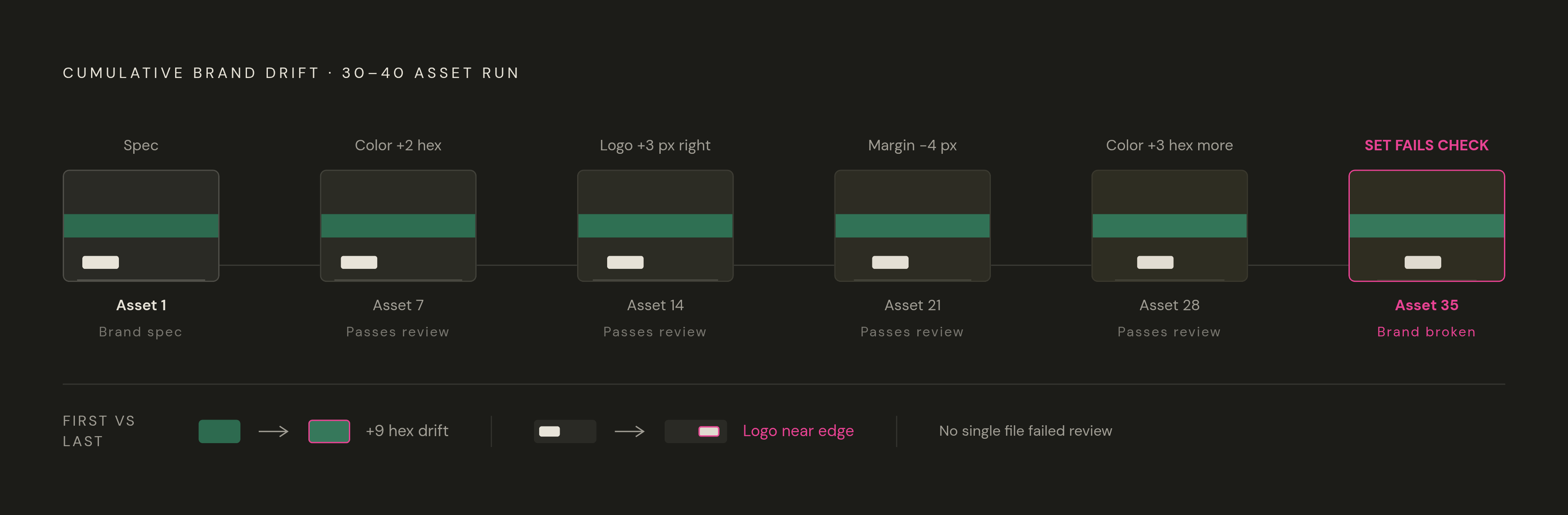
The single-image failure is visible, but a full production run makes logo fidelity degrade gradually across dozens of generations. A team can set clear brand rules, review each output carefully, and approve every individual asset, and logo fidelity will still degrade over the course of dozens of generations. Each prompt takes a slightly different path through the model's sampling process, and each of those paths introduces its own small, independent deviation. None of those deviations is dramatic on its own.
A color shifts three or four hex values from spec. A logo migrates a few pixels toward the edge of the frame. A clear-space margin that should hold steady shrinks by a handful of pixels. Any one of these, reviewed in isolation, passes approval, because it looks fine next to the asset before it and the asset after it. The trouble only becomes visible once someone lines up thirty or forty outputs side by side and realizes that the brand has quietly failed a consistency check nobody ran until it was too late. No single file set off an alarm. The run, taken as a whole, no longer looks like one brand.
What's missing is an enforcement layer: something that checks every output against the brand's actual specification and flags or fixes deviations before they go out the door. That kind of system is largely absent from current AI generation tooling. A 2026 roundup of brand compliance tooling names the gap directly: image generators are tuned to produce something that looks attractive, not something that conforms to a specification, so violations blend into otherwise good-looking work and slip through review. The result is a slow bleed rather than a single failure, brand quality draining out of a production pipeline one small, individually defensible deviation at a time.
What input fidelity controls do
OpenAI's image editing API includes a setting called input fidelity, and setting it to high tells the model to preserve distinctive features from a reference image rather than reinterpreting them from scratch. For a composite that includes a logo, face, or any other detail where exactness matters, this is a meaningful improvement over letting the model treat the reference as loose inspiration. OpenAI's own documentation points to this directly, describing the setting as useful for exactly this kind of editing task, and naming a specific use case for it: placing a logo or other brand asset into a template or lifestyle scene without unintended changes to the mark itself.
That's a real gain, and it should be the first tool anyone reaches for when a logo needs to survive a generation step intact. It also has a clear ceiling. Input fidelity preserves what's already present in the reference image, but it has no way to enforce brand rules it was never given. It can't verify that the empty space around the logo in the finished composite actually meets the brand's clear-space minimum. It can't check whether other colors in the scene fall within the brand's approved palette. It can't confirm that the final output matches the exact pixel dimensions a given channel requires. Input fidelity makes a single generation less likely to distort the logo itself. It does nothing to close the drift problem that builds up across a full run of assets, because it was never designed to check a result against a specification, only to hold a reference image steady during one edit.
The hybrid workflow is the most reliable current practice
Given those limits, the most dependable approach available right now doesn't ask the model to handle the logo. It separates the two jobs: let the model generate the background or scene, then place the official logo file into that scene as a separate, post-generation step. It's the correct division of labor given what each part of the process is actually good at, not a workaround born of distrust in the technology.
Guidance on using AI image generation for brand visuals makes this point directly: elements that are brand-critical, logos, wordmarks, specific typography, product packaging, exact color values, are safer to composite into a generated image than to ask a model to produce from scratch. The reasoning is straightforward. A model attempting to reproduce an intricate graphic pixel-for-pixel can introduce subtle distortions or misspellings where precision matters most; generating the scene around a logo rather than generating the logo itself removes that risk. Practical guidance on maintaining brand consistency across AI-generated images and video frames this as a production decision made in advance: know before generation starts which elements the model will create and which elements come from locked, approved assets composited in afterward.
That reliability comes at a real cost. The hybrid workflow brings back a manual step that AI generation was supposed to remove from the process. Every composite needs a designer, or at minimum a templated layer, to place the logo correctly, check its position against the clear-space rule, and confirm the final crop. At low volume, a handful of assets for a single campaign, this is manageable, even trivial. At the scale of a real campaign running across multiple channels with multiple size variants, that manual step becomes the bottleneck the team adopted AI generation to escape. The hybrid approach solves the problem of logo distortion within a single asset. It does not solve consistency across an entire run, and it doesn't scale on its own. It needs something underneath it.
Structured brand context, not better prompts, is what the model needs
The instinct, once drift becomes visible, is usually to write a better prompt: add the hex codes, spell out the clear-space measurements, describe the lockup rules in more detail. That helps, somewhat. It's also not a fix, because it asks a person to reconstruct the brand's full specification by hand, in prose, every single time an asset gets generated. That approach introduces its own interpretation errors, and it produces nothing that persists from one generation to the next or from one team member to another.
The actual root cause sits one level deeper than prompt quality. Brand guidelines are written for human readers, and a diffusion model has no access to a brand's lived history of how it uses its own language. A word like "clean" or "tech-forward" or "minimal" resolves, inside the model, to whatever pattern its training data associates with that word generally, not to the specific visual choices a given brand has made. Hex values, lockup rules, and clear-space measurements are precise, numeric, structural facts. Describing them in a sentence and hoping the model holds onto them through every step of image generation is asking prose to do a database's job.
Practical guidance on visual brand consistency points to the actual fix: token-based styling, where colors, spacing, and typography are defined as structured data. Update a token once, and every asset generated afterward reflects the change automatically, with no re-explaining required. The same logic applies to an AI briefing layer built from brand colors given as hex codes, font preferences stated explicitly, tone descriptors, and visual reference examples. That's a fundamentally different object than a prompt. A prompt is written fresh each time and discarded. A structured brief persists, and any tool or agent that needs to produce on-brand output can call on it directly. A 2026 comparative test of AI brand identity tools found real evidence for why this distinction matters in practice: the strongest predictor of consistency across a set of assets was whether the tool used the primary logo itself as a reference input when generating later assets. Tools built that way held onto visual continuity. Tools that generated each asset independently, without that reference, tended to produce work that matched on color but drifted apart in everything else, a set of images that shared a palette without sharing a visual language.
Brand infrastructure for AI composites in practice
Put together, this points toward a specific shape for what a working system should look like: the brand's full specification, colors as tokens, the logo as a locked file, lockup rules as structured parameters, channel dimensions as defined outputs, built into the workflow itself rather than kept in a person's head or a shared folder of PDFs.
Some of this already exists at the level of individual tools. OpenAI's image editing API supports logo preservation through reference-image input combined with high fidelity mode. A brand asset enters the generation call as data. Recraft, tested in a 2026 comparison of brand identity tools, generates real scalable SVGs and includes brand kits built specifically for creative workflows, so a logo exists as an actual vector object that survives resizing and format conversion without the rasterization artifacts that tend to break fidelity in flatter image formats.
The more significant shift is happening at the protocol layer: structured brand context no longer lives inside a single tool, but becomes something any AI agent can call on directly. The Model Context Protocol, released by Anthropic in November 2024, is an open standard for connecting AI assistants to outside tools and data sources, and by March 2026 it had reached a very large monthly download base, a sign of how fast it's being adopted across both development and marketing workflows. Knak shipped its own MCP server in April 2026, connecting AI assistants directly to a brand's stored brands, campaigns, and themes to generate production-ready email assets through the same rendering pipeline its visual editor already uses, so the output handles Outlook compatibility, dark mode, and responsive behavior the same way a hand-built email would. Canva offers a first-party remote MCP server as well, with documented access to brand kits and templates, design generation, targeted editing, asset uploads, and export to PDF, PNG, JPG, PPTX, and MP4.
None of this makes the underlying generation model smarter about what a logo is. What it does is close the information gap that caused the problem in the first place: the model is no longer guessing at a brand from fragments in its training data, because the brand's actual specification is sitting right there in the call it's responding to.