Brand Color Accuracy Across Diffusion Models
Text prompts can't reach the part of diffusion models where color actually lives.
A diffusion model cannot reliably hit a brand's exact hex code because color is stored in a part of its internal representation that text prompts simply don't reach. Research into FLUX.1 Dev's VAE (the variational autoencoder that turns the model's internal representation into pixels) shows that color occupies its own distinct, low-dimensional region of that space, one that can be read as cylindrical coordinates for Hue, Saturation, and Lightness. Shape and color live in separate dimensions of the model's internal representation. Typing "#FF5733" into a prompt does not touch the region where color is actually decided, any more than describing the taste of salt changes what's in the shaker.
It's a structural feature of how VAEs compress and reconstruct images, built into the geometry of the latent space itself, not something better training data, more examples, or a calibration pass could fix. A separate line of research on text-to-image "obedience" frames this as part of a broader pattern: models that can render an entire cyberpunk cityscape convincingly often fail at the far simpler task of producing a single uniform color, because the model's learned priors about plausible, "interesting" images override a user's deterministic, simple request.
The failure of hex codes in particular has a specific, well-documented cause. Color strings are passed through the model's text encoder before they ever reach the image-generating process, and that encoder has a known bias toward language patterns over visual precision. A string like "#FF5733" gets broken apart by subword tokenization into fragments that carry no coherent color meaning to the model, the same way chopping a word into random syllables destroys its sense. Research on numeric color control confirms this directly: hex codes and RGB values both get fragmented into tokens that the text encoder cannot map back to a consistent color signal. Whether a brand's design team types a hex code or a named color like "burnt orange," the instruction has to pass through a text channel with no reliable route into the pixel-level decision the model is making. Closing that gap means working with learned embeddings or direct intervention in latent space, not refining the wording of a prompt.
The latent color subspace and its structure
The latent color subspace is not a scattered, noisy cloud of values inside the model's representation. It takes the form of a clean, three-dimensional structure that researchers studying FLUX's VAE describe as interpretable in cylindrical coordinates, one axis for Hue, one for Saturation, one for Lightness. Picture a color wheel stretched into a cylinder: angle around the wheel gives you hue, distance from the center gives you saturation, height gives you lightness. That a model trained purely to reconstruct images organizes color this cleanly, with no instruction to do so, is itself a notable finding. And because the organization is consistent rather than incidental, it can be identified and worked with directly, without retraining the model from scratch.
The Latent Color Subspace (LCS) research backs that structure with two practical findings. First, the subspace can predict the color of the final image well before the generation process finishes: the model has effectively "decided" on a color early, and that decision is already legible if you know where to look. Second, and just as important, intervening directly in that subspace causally changes the output color in a controllable way. That second finding is the inverse of what happens when a hex code gets typed into a prompt: instead of a text instruction that the model may or may not follow, a direct edit to the region where color actually lives produces a predictable result.
Put together, these two properties describe something closer to a dashboard than a black box. A few steps into generation, before the image is finished rendering, the color the model is converging toward is already visible in the latent space, allowing correction at that point. That stands in sharp contrast to prompt iteration, where a team dissatisfied with the output color has no better option than re-running the entire generation again, hoping a new random draw lands closer to the target. The subspace is distinct enough, and ordered enough, to be a genuine target for intervention. What follows depends on that fact: once color is understood as a location in a structured space rather than an instruction to be followed, the question becomes how far off a default generation lands from where a brand needs it to be.
The gap between default model behavior and a brand-accurate target
Left to its defaults, a diffusion model's output color relative to a specific brand hex is close to random. Nothing in a standard prompt, including a hex code typed directly into the text, reliably narrows that randomness down to a specific, reproducible target. That is the baseline teams are actually working from every time a brand asset gets generated without additional intervention.
The Latent Color Subspace research gives a sense of how much headroom exists between that baseline and what's achievable. Using mechanistic color control, intervening directly in the subspace rather than changing the prompt at all, color accuracy on the GenEval benchmark rises dramatically, closing in on the level achieved by prompts that spell color out explicitly. The direction of that result matters: structural intervention gets a model most of the way to where an explicit, well-engineered prompt gets it, through the generation process itself. That's a wide gap between doing nothing and doing something, a gap that sits squarely inside the generation process itself.
That gap becomes a brand-equity problem the moment volume enters the picture. A single off-color image is a correction. Replicate that same inaccuracy across tens of thousands of AI-generated assets in a single campaign, and an isolated mistake turns into a systematic drift away from the brand's visual identity. The risk compounds further in agentic workflows, where assets get generated and published without a human checking each one, so an off-brand color error stays invisible until it's already live. The size of the gap between default behavior and a brand-accurate target is what makes that invisibility dangerous.
Architectural drivers of brand color accuracy
Not every model handles brand color the same way, and the differences between them are not a matter of taste. They trace back to architecture and tooling choices that either expose the latent color subspace to deliberate control or keep it sealed off behind a prompt box.
FLUX.2 models, for instance, support hex-code matching and character consistency through reference images, and their open weights let teams self-host and fine-tune on their own infrastructure. That openness is what makes mechanistic approaches like latent-space intervention possible in the first place: a team can only manipulate a model's internal representation directly if it has access to the model's internals, which closed, API-only systems don't offer. Midjourney, for its part, has made real progress on general color control with its V7 model, though pixel-perfect, exact hex matching remains unreliable there. A team that needs a specific brand hex reproduced exactly is better served looking elsewhere. Ideogram occupies a different part of the landscape entirely, built around typography and font control rather than color precision, a related problem but a distinct one from matching a hex value.
The deeper pattern across all of these tools is that even the ones with strong color-handling features solve the symptom, not the underlying coordination problem. A brand kit upload field, or a hex-matching feature built into a model's UI, helps within that one tool. None of them give a team a single, versioned, shareable definition of its brand color that any other agent or workflow, inside or outside that tool, can pull from. Each product maintains its own isolated copy of the brand's color context. Enter a hex value once in one tool's brand kit, and it stays there, unknown to every other model, pipeline, or agent the same team happens to be using. That isolation is the detail the rest of this argument builds from.
Research-backed techniques for improving color accuracy in diffusion pipelines
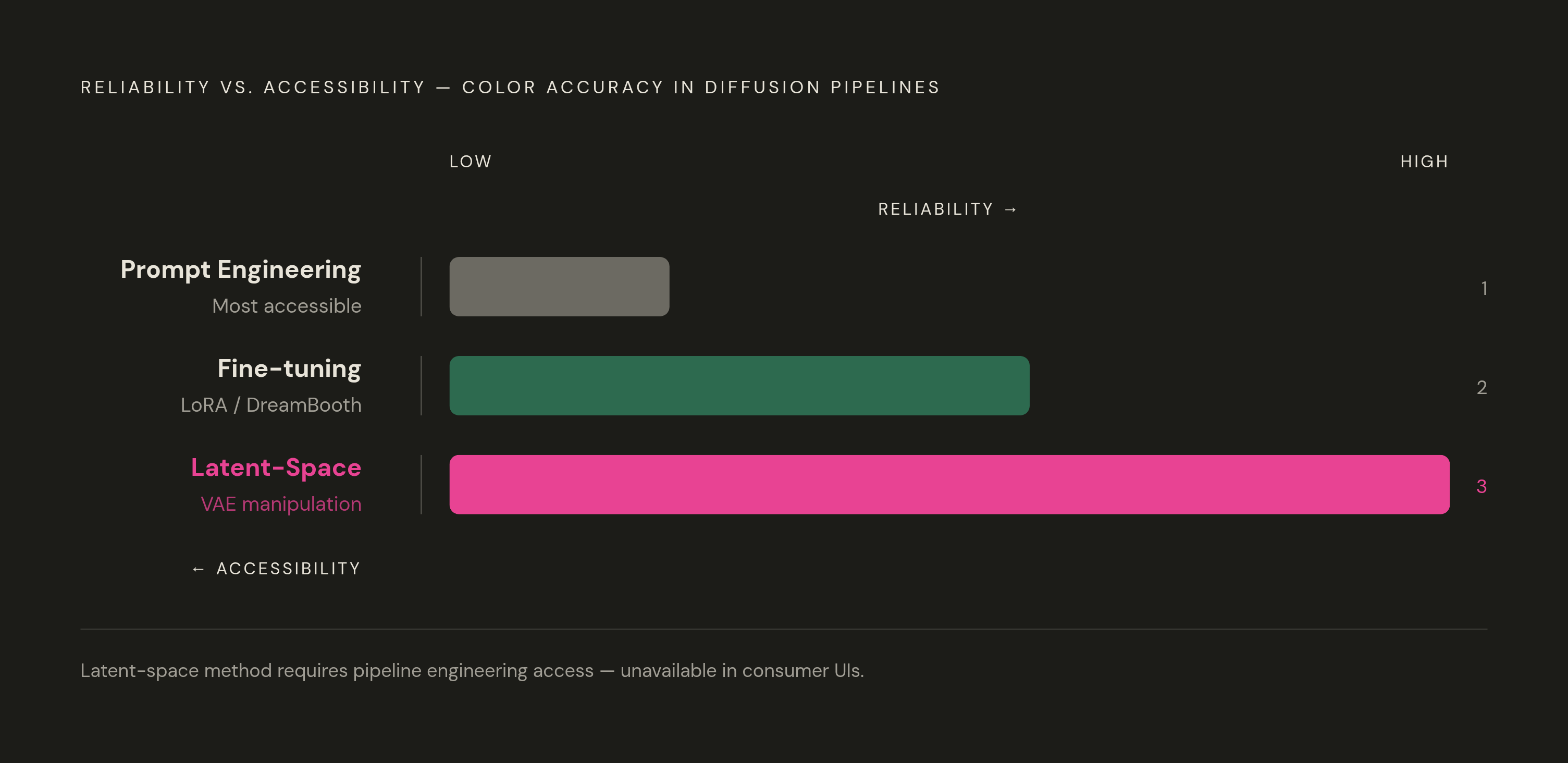
Three distinct points exist in a diffusion pipeline where color accuracy can actually be improved: the prompt, the model's weights, and the latent space itself. They sit at different levels of accessibility, and they differ sharply in how reliable the result is.
Prompt engineering is the most accessible of the three and also the least reliable. Named colors and hex codes alike pass through a text encoder with a documented bias toward language over visual precision, so even a carefully worded prompt caps out at modest, inconsistent gains. It's a reasonable first step for a team with no engineering access to the pipeline, but it's not a path to pixel-perfect, repeatable brand color.
Fine-tuning on a curated set of brand assets goes further. Techniques like LoRA and DreamBooth train a model on a brand's own images so that its visual language, including its color palette, becomes part of what the model has learned, rather than something that has to be re-specified in every single prompt. Both managed training services and self-hosted LoRA fine-tuning substantially outperform prompt engineering on consistency, the research behind these methods shows, though that improvement comes with a real cost: curating a usable dataset and setting up training infrastructure takes upfront investment that a prompt never requires.
Latent-space manipulation is at the far end of the spectrum, and the Latent Color Subspace research demonstrates it as a fully training-free method. Because the color subspace inside FLUX's VAE can be identified directly, a closed-form adjustment to that subspace can steer the output color without any additional training and without modifying the model itself. It's the most structurally sound of the three approaches, addressing color at the exact point where the model is making its color decision. It also comes with a hard constraint: this kind of intervention requires engineering access to the generation pipeline itself, access that consumer-facing model interfaces simply don't expose. A marketer working through a standard web UI has no path to this technique. A development team with pipeline access does, and the trade-off between reach and reliability is the real decision point across all three approaches.
The limits of model-level color accuracy at scale
Fixing color accuracy at the level of a single model, through fine-tuning, latent-space intervention, or careful prompting, solves the problem for one generation inside one tool. It does not solve the problem for a team running five, ten, or twenty AI tools across a single brand's content operation, because the color context those tools need lives in too many disconnected places at once.
Each model, each design tool, and each coding agent a team touches keeps its own private copy of brand color information. A hex value entered into Recraft's brand kit stays inside Recraft. It does not travel to a FLUX pipeline running somewhere else, and it certainly does not reach a code editor generating UI components for a product team down the hall. When a brand updates its palette, which happens on its own schedule regardless of how many tools depend on the old one, every one of those isolated copies needs a manual update. For a team working across five or more AI tools, that setup cost recurs as a piece of operational overhead every time the brand's colors change.
The agentic layer makes the consequences sharper and harder to manage. Bynder's Brand Compliance Agent audits assets across a brand's DAM library, checking for off-brand colors, incorrect logos, regulatory violations, forbidden objects, messaging problems, and other breaches of brand and legal guidelines. A tool like this exists precisely because agentic systems generate content at a volume and speed where checking each asset by hand stopped being realistic. The agent is compensating for something upstream that was never built: a shared, authoritative color definition that every generating tool could have checked against before the asset was ever created. Auditing after the fact catches problems once they already exist. Auditing after the fact does not stop problems from being created.
Adobe's own shift away from static brand guidelines points at the same gap from a different angle. The company has moved toward what it calls a brand ontology, a structured, continuously evolving model of brand standards built to be understood and applied by AI systems, extending beyond a human designer reading it. Decision traces, comments, edits, rejections, approvals, feed back into that ontology over time, strengthening it as more decisions accumulate. Adobe built this into its own ecosystem, but the approach extends outward too, reaching external agents and tools through APIs, MCP endpoints, and third-party integrations. The recognition behind that design choice is straightforward: a PDF full of color values is not a machine-consumable brand definition, no matter how carefully it's formatted. What's missing across the industry is a single, versioned, shareable source of truth for brand color that any agent, in any tool, can query before it generates anything.
What a machine-readable brand color definition requires
A brand color definition becomes machine-readable when any agent or pipeline can query it directly at the moment of generation, without a person in the loop to transcribe or re-enter it. That is a different bar than being well-documented, and most brand documentation today doesn't clear it.
A PDF brand guide, a Figma file, or a page in a style guide is built for a human reader. A designer can open it, find the hex value, and paste it into a prompt or a config file. That path works, but it requires a person to do it again, every single time a new tool or a new generation run needs that color, and it leaves every downstream system exactly as uninformed as it was before, since nothing about the document itself connects to any pipeline. When the brand's palette changes, that same PDF needs to be opened, read, and manually re-applied everywhere it was used before, with no automatic trace back to the tools depending on the old values.
A machine-readable definition is a different kind of artifact. It takes the form of structured data: a Markdown file with unambiguous, named color tokens, a JSON-LD annotation attached to brand assets, or an artifact reachable through an API. The distinguishing feature is that an agent can pull the current, correct value at inference time, the exact moment it's generating an image or a UI component, without waiting on a human to look anything up or paste anything in. Color accuracy that holds up not just in one well-controlled generation, but across every tool, every agent, and every future update a brand's palette will ever go through, is the structural requirement the rest of this piece has been building toward.