Video Model Color Grading Consistency for Brand Campaigns
Encode brand colors as machine-readable data before generation, not after.
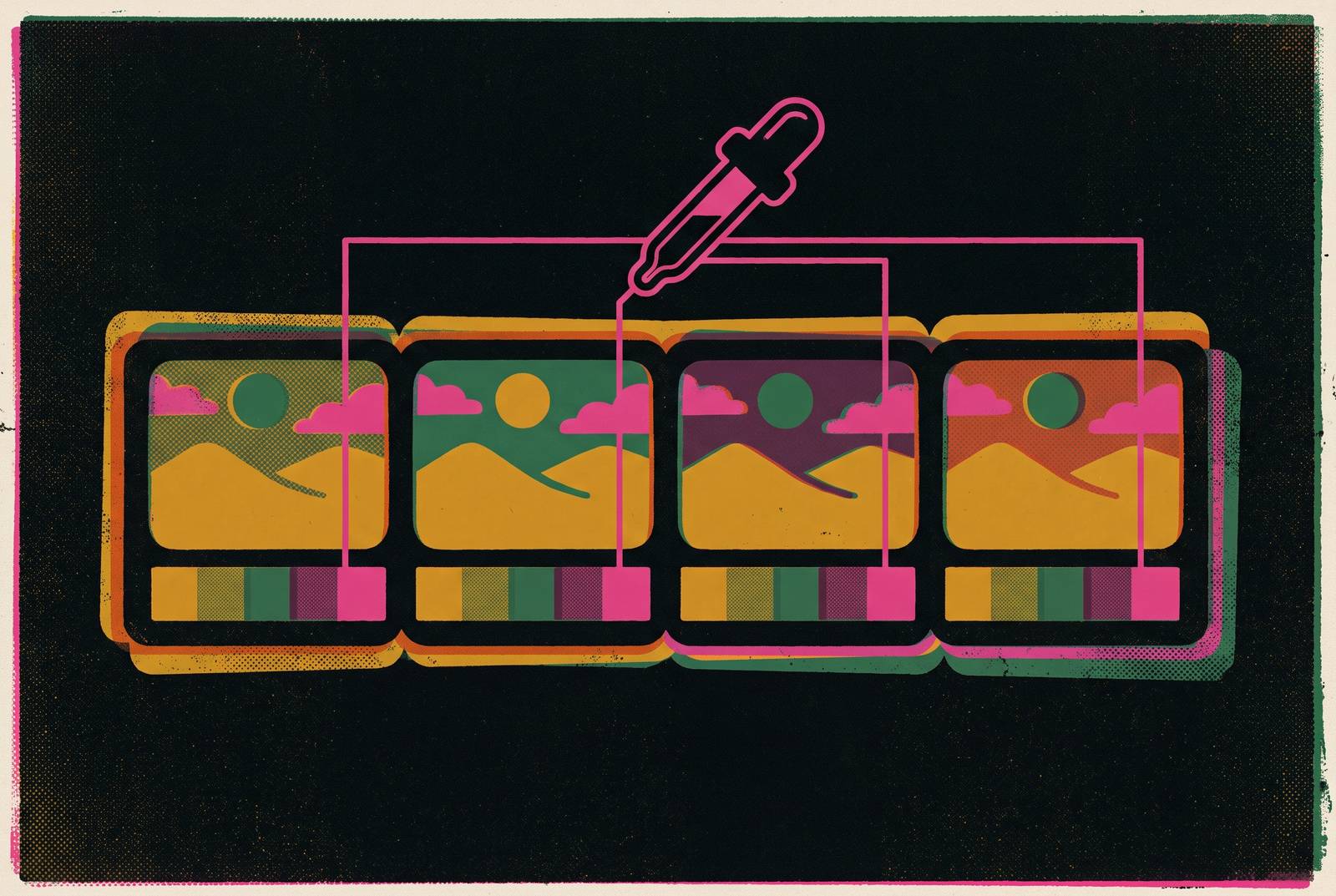
Brand color drift in AI-generated video is not a defect of the tools. It is a structural gap in how brand identity reaches the generation layer. Every call to a video model is a new interpretation, not a execution of a fixed specification, and the phrase "our signature blue" carries no stable referent inside a context window. Solving this means encoding brand color as machine-readable context that travels with every generation request, before the model ever samples a frame.
The failure mode is easiest to see in a single afternoon of work. A campaign manager prompts five clips with "use our brand blue" and receives five plausible but non-identical interpretations. The model is not disobeying the instruction. It is sampling from a distribution. A hex value pasted into a prompt can guide the output, but it does not guarantee pixel-level compliance across every generated frame, because the model reconstructs color from scratch each time rather than copying a fixed production master. What looks acceptable in one clip becomes visible drift across a ten-clip campaign, and the drift compounds with every additional generation.
Foundational AI models are trained on massive, largely unfiltered or minimally curated datasets. The problem is not that the model lacks precision. It is that the brand's identity was never given to the model in a form it could treat as authoritative.
The color problem is acute because color identity is expressed in language that is ambiguous without structured reference. "Signature blue," "warm corporate palette," and "brand-consistent tones" are human shorthand. They carry no machine-parseable specification unless something makes them precise at generation time. This distinguishes the AI color problem from the multi-camera grading problem, where Sony S-Log3 from an FX6 does not match S-Log3 from an A7S III out of camera, or Rec.709 from an iPhone mismatches D-Log from a drone. That is a technical capture problem with established correction workflows. The AI color problem is a context problem, and it has to be solved before generation begins.
Why chasing consistency in post-production is the wrong fix
Post-production AI grading can normalize color across a finished timeline, but it cannot recover a brand identity that was never encoded into the generation request in the first place. The tools are genuine and increasingly capable. Colourlab AI for DaVinci Resolve, priced at $14 per month or $129 per year for Creator and $39 per month or $299 per year for Pro as of September 8, 2026, does real work: reference matching inside Resolve without round-tripping, fast shot-to-shot normalization across a timeline. DaVinci Resolve itself, with its free tier and $295 one-time Studio license, remains the professional finishing environment, with scopes, qualifiers, and node-based grading for organizing corrections.
ImagineArt's AI video color correction tool illustrates the prompt-driven post-grading approach: describe a color look, apply it across the full clip. That is useful for finishing, but it still depends on a prompt description of the brand, not a structured specification. The precision ceiling matters. AI tools match palettes and equalize tones well, but they are not aware of a client's exact hex code or Pantone reference. On a broadcast campaign, a colorist with a vectorscope must still verify the final hero clip for Pantone compliance. No amount of automated post-grading removes that step.
The deeper limitation is that speed gains in post do not compound at the generation layer. Teams still receive inconsistent raw outputs that require correction every time, clip after clip, campaign after campaign. The correction is a per-clip, per-editor tax. It does not propagate a brand standard forward automatically. The fix needs to be at the source, the generation request, not at the end of the pipeline where the damage has already been baked into every frame.
What static brand guidelines actually fail to deliver to an AI model
A PDF brand guide sitting on Google Drive is not inert. It is actively absent from every AI generation request that does not explicitly quote from it, which is almost all of them. An AI prompt window does not read a brand manual. It reads what is in the context window at generation time. Prose descriptions of color are interpretable, not executable.
The same failure applies to brand voice. A guideline that says "use a calm, direct tone" gives an AI no constraint it can verify. A machine-readable rule does: "Tone = calm, direct, professional. Use 'adviser' (preferred); never 'clients.' Banned phrases: 'game-changing,' 'revolutionary,' 'synergy.'" That is checkable at output time. The visual equivalent is the difference between "use our brand blue" and a structured token with a hex value, RGB breakdown, and approved usage context. One is interpretable. The other is executable.
The root cause of AI color drift across campaigns is not that the tools are imprecise. It is that brand identity was never encoded in a form the tools can consume. This reframe matters because it moves the responsibility from tool selection to brand infrastructure design. The answer is not a better prompt or a better post-production pass. It is structured, machine-readable brand context delivered at generation time.
What machine-readable brand color context looks like in practice
Making brand color machine-readable means converting it into three specific types of artifacts that generation systems and agents can actually consume: structured tokens, locked reference images, and trained style weights. Design tokens are brand colors, typography rules, spacing scales, and visual parameters expressed as structured JSON schemas. They are not swatches in a PDF. A color token carries the hex value, the RGB breakdown, the approved usage contexts such as primary CTA, background, or text-on-dark, and any Pantone or color-space mapping needed for broadcast verification. When the brand updates its primary blue, downstream systems inherit the change automatically, so no team has to update their prompt library.
Locked reference images are a curated set of approved visual references passed into every generation call as image conditioning. They are not described in prose but provided as actual image inputs. Reference images constrain the model's color interpretation by anchoring it to a concrete visual rather than a verbal description.
Style fine-tunes, in the form of a custom LoRA or IC-LoRA trained on a small set of reference clips or images, deliver a repeatable, reusable visual identity rather than a one-off prompt match. LTX offers LoRA fine-tuning for motion, style, and identity in several hours, which changes the cost-of-entry calculation for brand teams. The trained weights live on the team's own infrastructure, making the brand's visual style a reusable, owned asset rather than a subscription feature tied to one vendor. Each one narrows the generation space the model samples from.
How generation-layer brand systems encode color at the point of output
A growing set of AI video platforms now treat brand color as a structured parameter at generation time rather than a prompt suggestion, and the difference in output consistency is material. Synthesia's Brand Kits, available on Enterprise plans, allow administrators to define colors, fonts, logos, and avatars and enforce approved kits across workspace videos. Enforcement, not suggestion, is the operative word. The color lives inside the system as a constraint that every generation must satisfy, not as a phrase the model is free to interpret.
LTX approaches the same problem from the color-science side. Its color-science-native pipeline takes 16-bit EXR in and returns 16-bit EXR out through an ACES workflow. It can also expand 8-bit SDR footage into 16-bit EXR in scene-linear ACEScg, so brand color grading applied in post operates on a color-science-correct foundation, not a compressed one. The brand's color values are being carried through the pipeline with engineering precision, not approximated after the fact.
The common thread across these approaches is that brand color moves from being described to being encoded. A structured parameter the system checks, not a phrase the model interprets. That categorical shift, from suggestion to constraint, is what changes output consistency at scale.
Why MCP is the right protocol for brand color context that travels across tools
Platform-specific brand kits solve the consistency problem only inside one vendor's environment. MCP solves it across every tool a team uses, regardless of which model is running. The Model Context Protocol is an open standard created by Anthropic and hosted by the Linux Foundation's Agentic AI Foundation, co-founded by Anthropic, Block, and OpenAI, with support from Google, Microsoft, and others. It enables secure, two-way connections between data sources and AI-powered tools.
For brand color specifically, an MCP server can expose structured visual identity, hex tokens, reference palettes, usage rules, and approved asset URLs, as something any compatible tool queries before it generates a single frame. A brand's color identity stops being one of millions of things a model half-remembers from training and becomes a source it checks in real time, at every generation request. Whether the team is generating on Claude, ChatGPT, Gemini, or a purpose-built video model, if brand context sits behind MCP, every tool reads it the same way. Webflow ships its own MCP server, so the infrastructure pattern is already standard across the design and content production stack.
One live risk deserves attention. Trend Micro found a significant number of MCP servers exposed to the internet with zero authentication as of mid-2025. Authentication and access scoping are non-negotiable requirements for any production MCP deployment. A protocol that makes brand context travel everywhere also makes it leak everywhere if the server is left open.
Building brand color as retrievable infrastructure, not a prompt library
The teams that will hold color consistency at AI scale are not the ones with the best prompts. They are the ones that have encoded brand color as versioned, retrievable infrastructure that any agent or tool can pull from without human intervention. Effective AI brand color governance requires three connected pillars working together.
Machine-readable tokens: color values, usage rules, and visual parameters in structured JSON schemas. Context injection: passing those parameters directly into AI agents and video generation tools via open protocols like MCP, so every request inherits the brand specification automatically. Automated validation: scanning AI outputs in real time to detect non-compliant color or visual elements before they reach publication. This closes the loop between what was specified and what was generated.
This is precisely what Bloom is built to do. It ingests a brand's existing assets, guidelines, design systems, and approved visual references, and transforms them into a structured Brand Skill that any connected agent or tool can retrieve via API or MCP. Brand color context becomes versioned: when the primary palette updates, every downstream tool that queries Bloom inherits the change automatically. Teams managing multiple brands or clients can maintain separate, scoped Brand Skills in one workspace. Agents operating in Claude, Cursor, ChatGPT, or any MCP-compatible environment can query the same canonical color specification.
The alternative, each team member manually pasting brand color values into every prompt and maintaining their own local copies of the guidelines, does not scale and does not version. Brand color treated as infrastructure changes the operational model. Instead of a per-clip QA burden, the brand specification is a precondition built into every generation request from the start.
Where human colorists and emotional judgment remain necessary
Structured brand color context constrains AI generation effectively at scale, but it does not replace the human judgment required for broadcast-precision compliance or for the emotional calibration that makes a campaign feel right, not just look correct. For brand-Pantone compliance on a national broadcast campaign, no automated AI tool matches the surgical precision of a colorist working on a calibrated suite. At that level of work, a human colorist with a vectorscope remains the verification layer.
The deeper limit is not technical but interpretive. AI models are excellent at following structural instructions and matching colors, but they lack the emotional intelligence to understand the complex connection between a brand and its customers. The human is the one who decides whether the blue in a particular scene feels confident or cold, reassuring or distant. That judgment is not in a JSON token. AI can balance color across thousands of clips. It cannot decide what a brand should feel like in a specific cultural moment or campaign context.
The practical model that follows is a hybrid workflow. Use structured brand context to constrain and automate the volume work: campaign variants, social cuts, regional adaptations. Reserve human colorist time for hero shots, broadcast deliverables, and the emotional calibration of the campaign's defining visual moments. In practice: AI generation with brand context injected, then AI post-grading for normalization, then human QA against Pantone and broadcast spec on hero assets, then validation against the brand token set before publication. That sequence keeps the automation where it compounds and the human judgment where it is irreplaceable.
The workflow shift: from prompt discipline to brand context as a precondition
The practical change is not adopting a new tool. It is moving brand color specification from something individuals manage in their prompts to something the team's infrastructure provides automatically at generation time. Each generation request depends on someone remembering to specify it correctly, and there is no single source that updates downstream tools when the brand evolves.
The target state is different in kind. Brand color becomes a versioned, queryable artifact: tokens in a schema, references in an asset library, style weights in a trained file. It travels with every generation request without manual intervention.
The transition has three practical steps. Audit and encode: take the brand's existing color specifications and convert them into structured tokens, hex values, RGB breakdowns, usage rules, Pantone mappings, in a format an agent or generation tool can consume. Connect via protocol: make those tokens available through MCP or API so every tool the team uses can query the same source, whether that is Claude, a video generation model, or a design agent, without each tool maintaining its own copy. Version and validate: treat brand color updates the way code updates are treated. Versioned, with downstream systems inheriting the change, and with automated validation checking outputs against the specification before publication. This is the shift from thinking about AI as a creative tool that needs good prompts to thinking about brand context as critical infrastructure that the tool consumes. It is the same reframe that turns AI-assisted marketing into AI-native brand operations.