Prompt Consistency and Brand Style Drift in Long Image Runs
Diffusion models have no memory, so drift is inevitable without a visual reference frame.
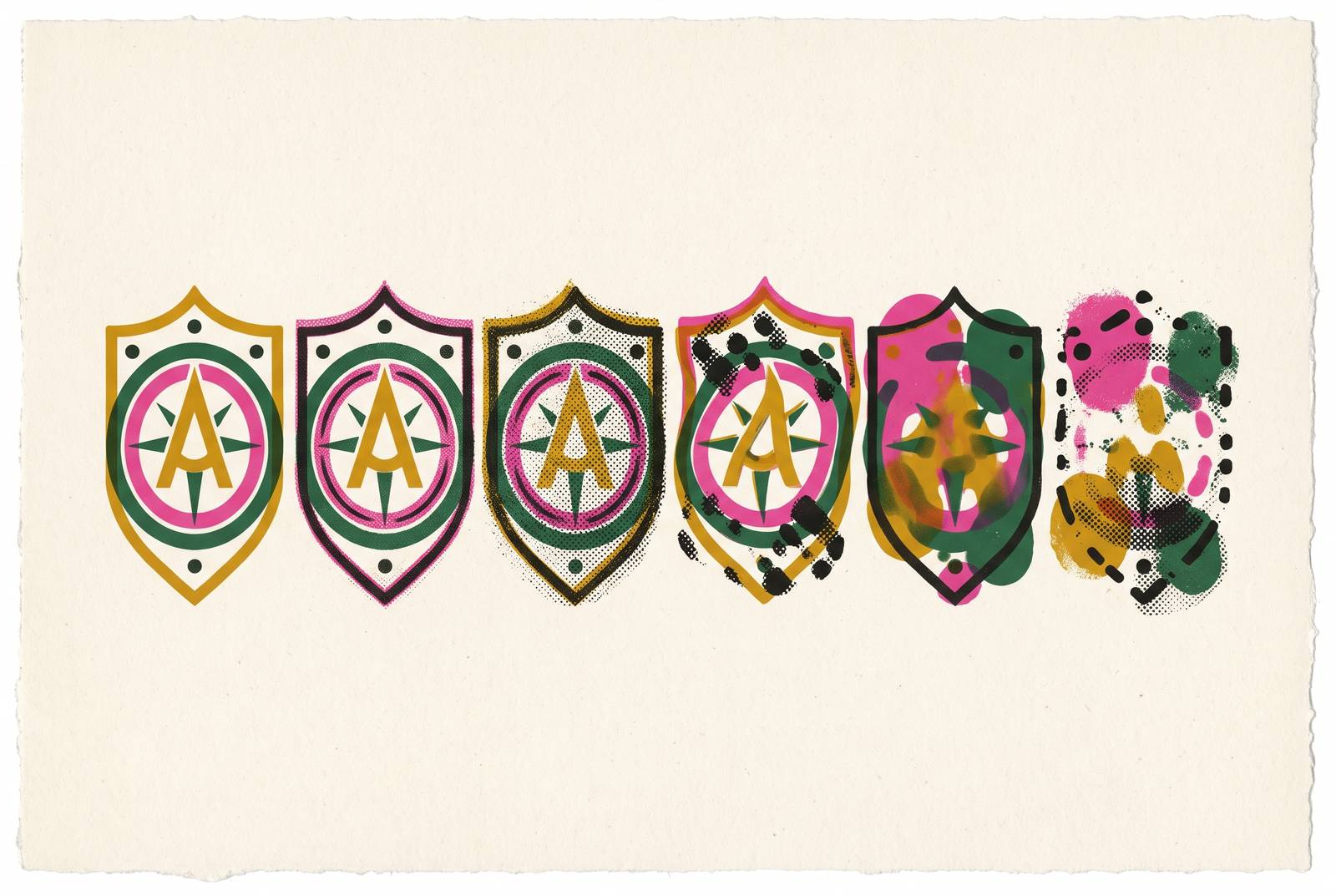
Brand style drift in long AI image runs is built into the architecture of diffusion models, not caused by sloppy prompting. Every generation starts from random noise and takes shape based only on the text supplied in that moment. There is no memory carried from one output to the next, no retained visual frame that a model consults before rendering. A prompt like "product photography on a clean white background, warm lighting, minimal aesthetic" will produce images that technically satisfy every word of that description while differing from each other in warmth, shadow softness, composition, and color temperature. Three failure modes are baked into text-only prompting. Color interpretation varies because a phrase like "warm tones" gets read differently by every model and every run. Lighting drifts because "natural light" could mean dawn, midday, golden hour, or an overcast afternoon, and the model commits to one reading each time it generates. Composition defaults shift because each model carries its own learned preference for framing and subject placement, so identical text produces different layouts across models and across the people typing the prompts. None of this is a defect to be patched. It is the expected behavior of a system with no visual reference frame, operating exactly as it was built to operate. Refining the wording does not touch the underlying mechanism, because the mechanism has no persistent state to refine.
What drift looks like across a real campaign
Drift appears as specific, recognizable breakdowns in output, and those breakdowns compound as output volume and team size grow. Four patterns appear repeatedly. If you leave out explicit color direction, palettes shift, and assets meant to sit on the same page end up clashing instead. When instructions stay vague, lighting turns inconsistent, so a single campaign ends up with a mix of polished, professional-looking frames alongside others that read as amateur. When team members reach for different descriptive language, style drifts, and the brand looks disjointed across channels even though everyone believed they were following the same direction. Mood whiplash sets in when artistic style varies from asset to asset at random, which prevents an audience from ever building the visual recognition that repeated exposure is supposed to create. Team size multiplies the damage. One person writing prompts inconsistently produces moderate drift. Five people writing prompts independently produces something closer to visual chaos: the same scene described as "clean and modern" by one teammate, "minimalist" by a second, and "contemporary" by a third yields three distinct aesthetics from what was meant to be one brand. Brand recognition depends on visual consistency, so when AI-generated visuals shift from one asset to the next, that recognition erodes, and this carries real weight for revenue. What looks tolerable across a handful of images turns into a governance problem once volume rises, because drift does not stay proportional to the number of assets you produce.
Why better prompts cannot solve a stateless problem
The natural response to drift is to write better prompts: more specific, more detailed, more carefully worded. Prompt refinement can help a single output, but it cannot build the shared, persistent visual frame that a campaign needs for consistency. Specificity narrows variance without eliminating it. A phrase like "cobalt blue zip-front track jacket with white stripe on left sleeve" will drift less than "blue jacket," but the next team member, the next session, and the next tool all start from nothing regardless of how precise that earlier phrase was. A designer absorbs a brand over months and carries that understanding from project to project without needing to be reminded. An AI generation carries nothing forward: every session, every contributor, and every tool begins with zero accumulated context, no matter how well the last prompt was written. Prompt templates run into the same ceiling. They reduce variance when a team enforces them consistently, but the written descriptors inside a template still get interpreted differently by every model and every generation, making a template a supplement at best, not a solution. This isn't a case for abandoning careful prompting. Teams that over-correct by piling on more and more qualifiers often find diminishing returns, because no amount of wording can substitute for a reference the model actually holds onto. Drift is a context problem: it is the absence of a persistent, shared visual frame that every generation, regardless of who triggers it, can draw from.
What "structured brand context" means
A style guide is written for people. Structured brand context is addressable, queryable data that an AI tool can consume directly; that is an architectural distinction. A style guide describes identity in prose, phrases like "our voice is conversational" or "we use warm tones," which a human designer reads and interprets using years of accumulated judgment. A model has no equivalent judgment to draw on, so narrative description gives it nothing to act on reliably. Structured brand context instead encodes identity as explicit fields a system can query: term lists, sentence-length constraints, tone parameters sorted by content type, banned vocabulary, required formatting, and output templates. Color offers a clear example of why this matters. Image generators process color linguistically rather than numerically, so a phrase like "deep British racing green" activates far stronger associations in the model than a hex code ever could, and "warm off-white, paper-like" produces more accurate results than a color value expressed as a code. Camera and lighting references carry even more leverage. A specification like "shot on 85mm f/1.4, soft natural window light, warm color temperature" produces far more consistent results than qualitative language such as "professional" or "cinematic," because the technical phrasing activates specific visual associations the model learned from millions of tagged training images, while the vague adjectives leave the model guessing. Design tokens give this structure an operational form: they bridge brand guidelines and any system that needs to apply them, AI agents included, and the token file works as a single source of truth across every output format a brand produces. The architecture that makes all of this work requires a deliberate split between two layers. One layer faces machines, so it strips away narrative and hands rules over as direct, structured instructions. The other faces people and preserves the rationale and story behind those rules, because a human reviewer still needs to understand why a decision was made even when a model only needs to know what to do.
Reference Conditioning and Saved Style Elements in Practice
Closing the gap between what a prompt describes and what a brand actually looks like requires giving a system a visual reference, not simply writing better text. The most dependable version of this is a single Style Element: one reference set, saved once, that captures palette, lighting, finish, mood, and composition together, then called into any prompt so that every contributor produces on-brand output starting on day one. A Style Element typically covers an entire aesthetic at once because that reflects how a visual style actually functions: as one unified whole. Reference conditioning means attaching a prior image as a style anchor. It works well for one-off projects and style exploration, but a 2026 analysis found it achieves typical visual similarity fidelity of only 70 to 80 percent across character generations. At scale, this carries a compounding cost, because you have to re-attach the reference image each session, and different team members may reach for different references without realizing it. Mixing image generation tools within a single project reintroduces drift even when a reference is in use, because each model carries its own learned compositional defaults, so identical prompts and even identical references can still produce distinct results across tools. Several products illustrate how this plays out. Adobe Firefly's Style Kits let teams share reference images, effects, and prompts for consistent on-brand generation, and a separate Custom Models feature allows fine-tuning on a team's own assets so that generated images match brand identity across color palette, composition, and lighting direction without manual instruction on every prompt. Runway's Gen-4 introduces world consistency, maintaining consistent characters, locations, and objects across multiple scenes from a single reference image, which makes it possible to produce a full campaign of video content featuring the same character across different environments without a physical shoot. Claude Design reads a company's codebase and design files during onboarding to build a design system automatically, so that projects created afterward use the brand's colors, typography, and components without someone re-specifying them each time. Each of these tools solves the problem within a single tool and a single session. None of them, on their own, solves consistency across tools, across sessions, and across an entire team, because that requires something that persists and propagates on its own.
Persistence and Propagation Require an Infrastructure Layer
Good brand context in one session, held by one person, inside one tool, does not solve drift. Drift ends only when every agent, tool, and contributor pulls from the same source automatically, and nobody has to remember to attach anything. The trouble begins the moment brand context lives in a file, a PDF, or a saved element inside a single tool: at that point it is a copy, and copies diverge. If someone does not manually carry that context over, the next team member, the next tool, and the next session all start without it, and manual transfer is exactly the kind of step that gets skipped under deadline pressure. Updates make the problem worse. When brand guidelines change, a new color, an adjusted tone standard, a retired visual treatment, every copy sitting in every tool has to be updated by hand, and in practice most of them never are, so outdated context keeps generating off-brand work long after the guideline itself has moved on. The alternative is a single canonical, machine-readable source of brand context published to a live connection that any AI session can pull from directly. If you update that one source, every future output across every connected tool reflects the change automatically, and no manual redistribution is required. Software went through the same transition when version control became foundational: a codebase stopped being a set of files passed around by email and became a single tracked source every contributor pulled from. Brand identity deserves the same treatment: a change that does not propagate everywhere it needs to isn't really a change at all; it's just a note sitting in one person's files. Agencies and teams managing multiple brands feel this pressure hardest, because they have to maintain separate, manually synchronized copies of context for each brand across each tool, and that overhead compounds with every brand they add to the roster. Bloom's Brand Skill answers this directly: a versioned, retrievable representation of a brand's aesthetics, voice, references, and assets, ingested once from a team's existing materials and made accessible via API or MCP to any connected agent or product, so that every downstream system inherits the latest version automatically, without anyone manually distributing updates.
MCP and Structured Brand Context at the Agent Layer
Model Context Protocol, or MCP, is the mechanism that turns a static brand document into a live, queryable resource any compliant AI agent can pull from in real time. MCP is hosted by the Linux Foundation's Agentic AI Foundation, co-founded by Anthropic, Block, and OpenAI, with additional support from Google, Microsoft, AWS, Cloudflare, and Bloomberg. Its architecture exposes three kinds of resources that any compliant client can speak to: tools, which are functions the model can call; resources, which are data the model can read; and prompts, which are reusable templates. For a brand team, the use case that matters most is document retrieval. Rather than pasting guidelines into every single prompt, a brand context published as an MCP resource can be pulled by name into any compliant environment, including Claude, Cursor, ChatGPT, or any other MCP-compatible agent. The most reliable setup is a live connection, an MCP link or a single canonical, machine-readable URL, so that every AI session reads from the same place, and updating that source updates every future output across every connected environment at once. A workflow published over MCP functions as both a REST endpoint and a hosted tool: an agent such as Claude can list it, run it against a typed brief, and receive image URLs in return, and because the workflow runs as a visible canvas rather than a hidden prompt chain, the exact graph it called and the exact prompt it sent remain inspectable. Webflow launched MCP 2.0 on July 21, 2026, adding governance, brand control, and analytics for agent-driven website management, and named adopters give a sense of what that looks like in practice. Arkose Labs migrated a decade-old WordPress site to Webflow using Claude Code via MCP in 3.5 weeks. Amazon Ads Brand Innovation Lab adopted workflows combining Figma, Claude Code, and Webflow's MCP. Bloom's own MCP integration operates on the same principle: a Brand Skill is accessible via MCP to any compatible environment, so Claude, Cursor, or any other connected agent can retrieve the exact brand context relevant to the task at hand, without a team member pasting guidelines into each new prompt.
What it takes to make a brand agent-ready: the practical checklist
Making a brand agent-ready is a one-time structural investment that replaces the habit of re-constructing prompts every session with a system that propagates brand context on its own. The work breaks into seven steps, each building on the argument laid out above. Audit existing brand assets for machine-readability first: gather guidelines, visual references, design tokens, and voice documentation, then separate what is written for human readers in narrative prose from what needs restructuring into explicit, queryable rules. Extract visual DNA as structured data next, translating color into named descriptors such as "deep British racing green" rather than relying on hex codes alone, encoding lighting as camera and technical references like "85mm f/1.4, soft natural window light" instead of qualitative terms, and defining composition rules separately for each use case, since a social post and a campaign hero image call for different framing. Separate the machine-facing layer from the human-facing layer, so the machine-facing guide delivers term lists, sentence-length constraints, banned vocabulary, and required output templates as structured instructions, while the human-facing layer keeps the rationale intact for people who need to understand the reasoning behind a rule. Publish everything to a single canonical source, one live connection such as an MCP server or a canonical machine-readable URL, so every tool queries the same place instead of a scattered collection of copies, and an update you make once propagates everywhere. Version brand context the way software teams version code, treating every change to color standards, tone parameters, or visual treatments as a tracked update rather than a silent edit to an untracked document, so connected agents inherit the latest version automatically. Pick one image generation model per campaign and enforce it, since mixing models reintroduces inconsistent compositional defaults no matter how well you have structured the underlying brand context. Make a human review checkpoint a required step rather than a fallback, because a review workflow catches off-brand outputs, rights issues, and compliance gaps before they compound across hundreds or thousands of assets. Bloom was built as the infrastructure layer for exactly this workflow: it ingests existing brand assets, structures them as a versioned Brand Skill accessible via API or MCP, and connects to Claude, Cursor, ChatGPT, and any MCP-compatible environment, so every downstream agent works from the same brand context without manual distribution or per-session prompt construction. This lets output stay on-brand reliably, no matter how much a team scales, so nobody has to check every image by hand before it ships.