Multi-Tool Brand Incoherence Traced to the Absence of a Shared Runtime Dependency Not a Prompting Problem
Agents drift off-brand because they lack one shared, versioned brand source.
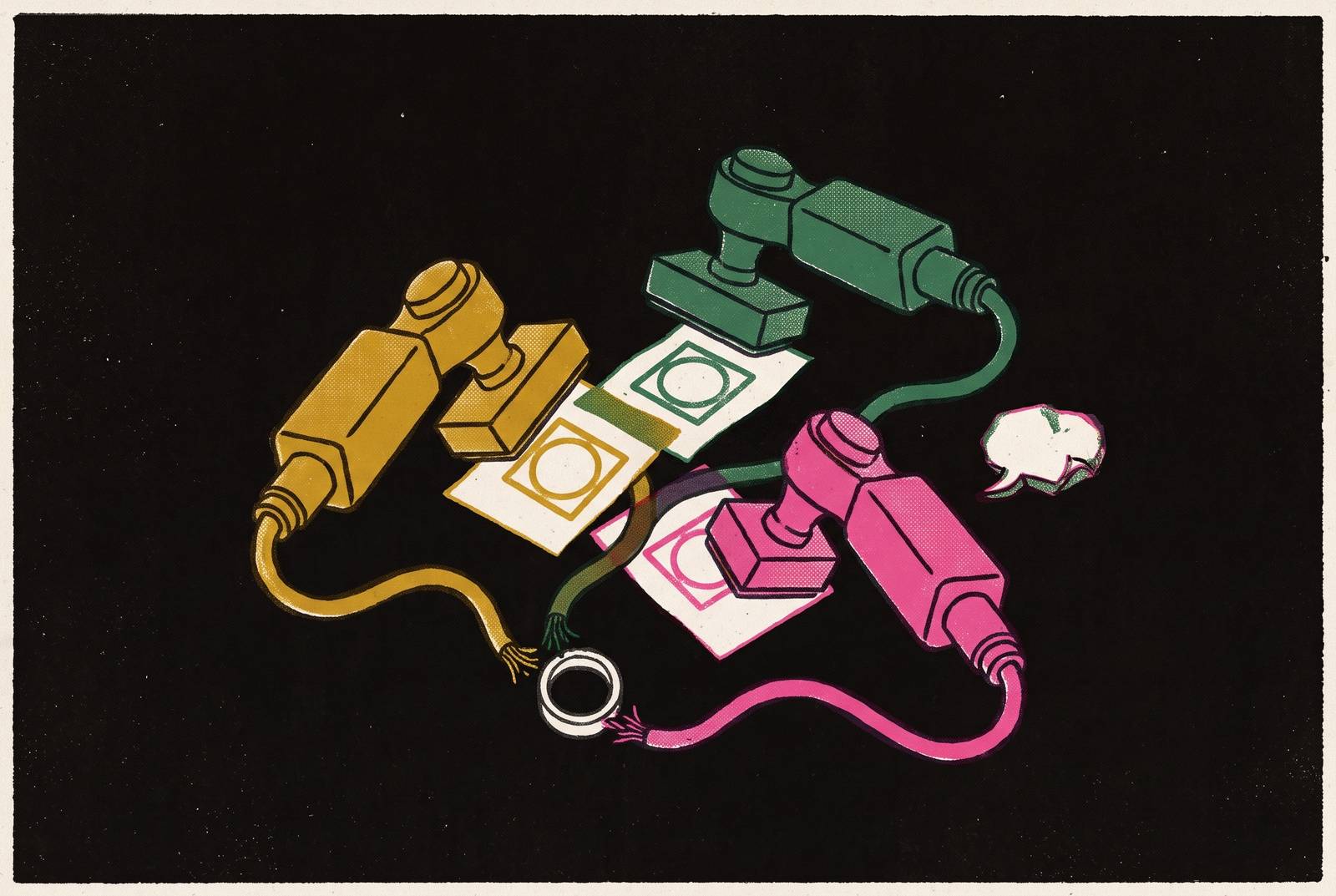
Detecting when AI output drifts off-brand requires checking finished work against explicit brand rules, with evidence for each violation. Preventing drift across multiple agents requires those agents to draw from the same versioned brand context at execution time. Multi-tool brand incoherence is therefore a missing shared runtime dependency.
How multi-agent workflows create a brand consistency problem that prompt engineering cannot solve
A campaign can contain a polished email and a competent ad that do not sound like the same brand. Each asset satisfies its local brief, yet the pieces disagree because the agents producing them interpret brand context independently. When specialized agents handle research, drafting, personalization, and distribution, individual quality does not establish campaign coherence.
The earlier, single-tool workflow had a natural checkpoint. A marketer or designer touched each asset before it moved forward, reconciling differences as the work passed between tools. Multi-agent orchestration removes that human from the handoff without necessarily replacing the reconciliation function. Brand governance consequently becomes an architectural responsibility rather than an implicit part of someone's production work. Without an explicit substitute, drift accumulates at the seams.
Why prompt engineering is a task-level fix applied to a system-level problem
Careful prompt engineering improves what an agent produces in a particular session. It can clarify the task and express the brand constraints that apply to it. Task-specific prompts remain session-bound and invisible to other agents unless the system explicitly shares them. Refining one agent's instructions does not give another agent the same understanding.
When a brand rule is revised and instructions live in independently maintained prompts, someone must apply the change to every copy. Until that work is done, different agents follow different standards. Those copies also provide no single record of which rules governed a particular asset, making retrospective review harder. The system has no authoritative brand state.
A stronger underlying model does not resolve that gap. Model quality affects what an agent can produce, while workflow architecture determines which standards it receives and which constraints apply before publication. Prompt refinement and better models can improve individual outputs without correcting the distribution of brand rules.
What a shared runtime dependency actually means in a brand context
Software dependency management provides a precise analogy for this distinction. A shared registry manages dependencies centrally, whereas copying them into individual projects creates separate maintenance obligations and version drift. Brand instructions copied into each agent's configuration have the same weakness. A shared runtime dependency instead gives every agent a single, versioned source of brand context to query when it executes.
That source must be authoritative, versioned, and runtime-accessible. Authoritative means one source rather than competing copies, while versioned means changes are tracked and timestamped. Runtime access means agents get context when they run instead of using rules built into their configuration. This separation lets brand rules change without manually reconfiguring every connected agent. The source owns the rules, and the tools consume them.
The context must also support machine interpretation. A human-readable guideline that calls for a warm and direct tone leaves whoever reads it to decide what that means. A machine-readable schema expresses tone parameters with their source, confidence, and timestamp. The same principle favors design tokens over color guidelines, structured content models over narrative style documents, and explicit parameter ranges over mood words. These structures give agents and reviewers the same rules to work from.
How MCP provides the transport layer for a shared brand dependency
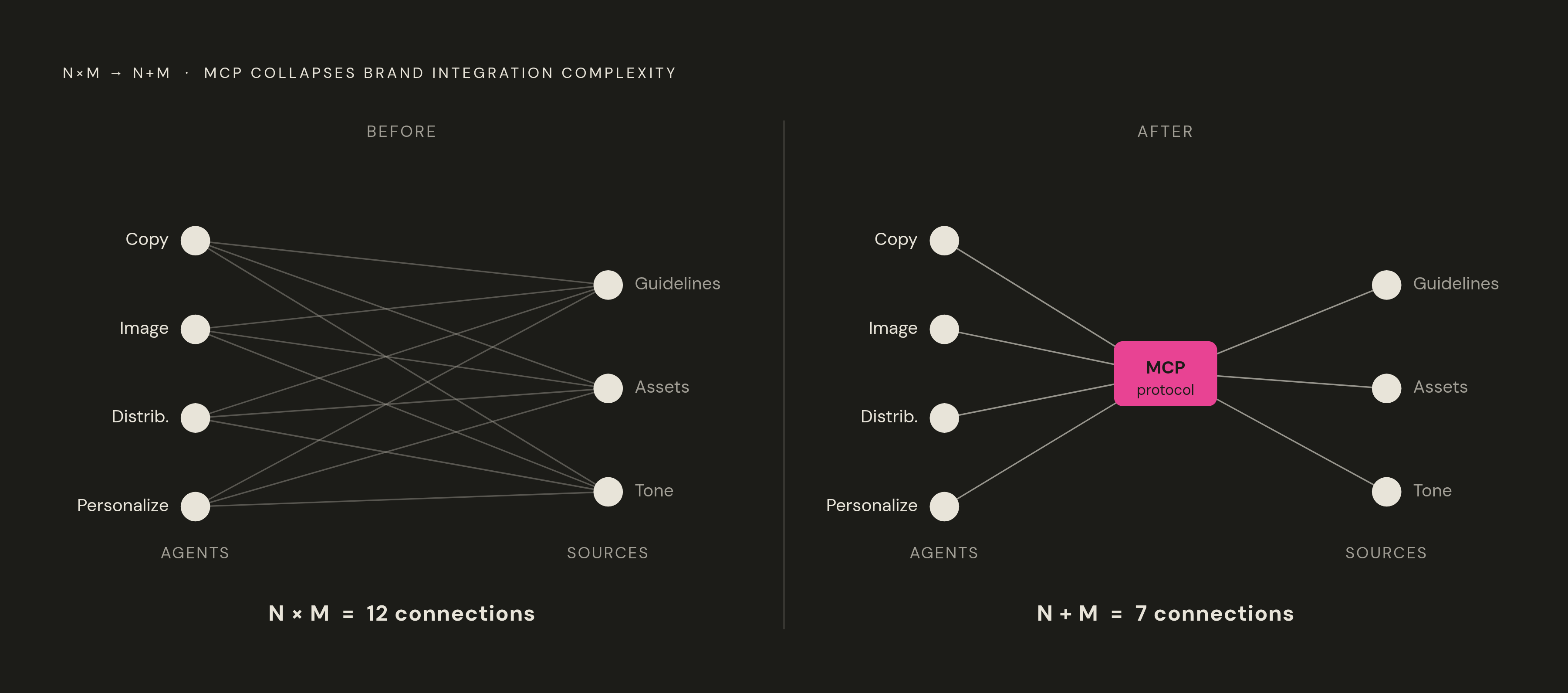
Anthropic open-sourced the Model Context Protocol to give agents a standard way to pull context from systems where data lives, including content repositories, business tools, and development environments. MCP is an interface that connects compatible agents to external tools and data. It removes the need for a bespoke connection between every agent and every source. The integration pattern changes from N×M to N+M because each agent and each source implements the protocol once.
For brand context, that interface exposes resources, tools, and prompts. Resources provide read-only structured data such as voice guidelines, approved asset libraries, campaign briefs, and a product catalog. Tools have functions that can retrieve a campaign brief or check an asset against brand rules. Prompts supply templated instructions for working within brand constraints on a given task. These capabilities separate access to brand information from the actions performed with it.
As a result, copy, image-generation, and distribution agents can retrieve the same guide, library, and brief within one workflow thread. The marketer need not reconstruct context at every handoff. Anthropic donated MCP governance to the Linux Foundation's Agentic AI Foundation, with Anthropic, Block, and OpenAI as co-founders. That institutional backing supports the transport's broader use, but does not establish the quality of any particular brand source. Standardized connectivity is not equivalent to governed context.
What the shared brand dependency looks like in production — Frontify's MCP server and the Figma design system
Frontify illustrates how an existing brand portal can serve this architecture without creating a second source of truth. Its MCP server connects agents to the brand context held in the portal. Its AI brand checker reviews creative assets for color, logo, typography, and clear space against the brand's guidelines. It supplies pass/fail scores, remediation suggestions, and automatic routing into review workflows. The architecture therefore supports both access to rules and review against them.
Figma made its MCP server generally available at Schema 2025. Coding and design agents can retrieve actual component names, spacing tokens, and accessibility properties from the live design system. They need not work from a snapshot or a human-written summary. This is the design-system expression of the same dependency principle, with the canonical source supplying the details agents use.
HubSpot made its remote MCP server generally available to all HubSpot accounts on April 13, 2026, with read and write access. This supports a campaign workflow in which an agent retrieves a voice profile, generates an asset, and logs the result to HubSpot without reconstructing context between steps. Block operates an internal agent architecture built on over 100 of its own MCP servers for its workforce. The transferable pattern replaces many bespoke integrations with few agents using many reusable standard connectors. These implementations demonstrate the architecture.
The agency case — why multi-brand operators feel the dependency problem most acutely
Every new agent, campaign, and client update adds places where someone must configure or revise brand instructions. Account teams previously held much of that context in memory and applied it at each handoff. Removing those handoffs also removes their corrective function. The cost of brand switching becomes a property of the workflow rather than an occasional administrative inconvenience.
A multi-brand workspace changes that relationship by holding each client's brand kit, voice profile, and approved assets as a shared dependency. The same agent can switch between client contexts without rebuilding its configuration. Advercy, a one-person agency, used a single workspace for multiple client brands and reported increased creative volume and reduced cost per lead. Those reported results do not show how much each workflow change helped.
With per-agent instructions, the agency must update prompts across every affected agent and campaign. With a shared dependency, the authoritative context changes once and propagates to connected agents. This model scales brand maintenance by separating client context from the tools that use it, rather than treating every tool as another place to store the brand.
The legitimate objection — multi-agent systems can amplify errors, and a shared bad context is worse than no shared context
A shared brand dependency is also a single point of failure. If its context is stale, misconfigured, or wrong, every agent drawing from it can produce wrong outputs simultaneously. Centralization can therefore make an error more widespread, even as it removes disagreement between agents. A system that reliably distributes bad guidance has solved synchronization while worsening governance.
The answer requires more than adding a connection. Brand context must be treated as an auditable artifact, with a known-good version, a changelog, and a rollback path. Access controls must govern changes, while an audit trail establishes which context was in effect.
Context cost creates a separate constraint on the architecture. Each connected tool describes its schema to the model, and many connected tools can consume a meaningful share of available context before task-specific input is processed. A standard interface does not remove that cost. The case for shared dependencies is consequently conditional on governing the source and accounting for the context consumed by its connections.
Detecting when AI output drifts off-brand requires versioning, review, and an update propagation contract
Detection starts with clear criteria, which give reviewers more to go on than a feeling that an asset is wrong. Relevant signals include violations of tone parameters, campaign messaging rules, approved color specifications, logo rules, typography, and clear-space requirements. Each signal must point to a rule in the brand version that applies. Otherwise, reviewers may identify inconsistency without being able to establish which standard the asset should have followed.
The audit system begins with named, timestamped versions of brand context. Each output should be associated with the rules in effect when it was produced, so a review can distinguish an execution error from a change in guidance. This association also supports debugging and rollback. A shared source without version control cannot reliably explain the state under which an asset was generated.
The update propagation contract defines what happens when guidance changes. A new logo, a change to a voice rule, or a shift in campaign messaging should reach every connected agent automatically, without someone having to reconfigure each one by hand. Generation history alone is not sufficient, however. Finished work should also be checked against the current brand version before publication, so review applies the standard required at the point of release.
That review needs evidence for each check. A pass/fail score can express the result, but it cannot by itself explain which rule was violated or why the assessment was made. An auditable review ties the finding to the rule and the evidence in the asset. For agencies, this record belongs to the individual client brand, with its own version history and review trail. Shared infrastructure must keep each brand dependency separate from the others.
What teams building on this architecture need to put in place
Teams should convert narrative guidance into parameterized rules that agents can apply and reviewers can test. Those rules then need one authoritative location, such as a brand portal with an MCP interface or a versioned brand context server.
Connections should use MCP for compatible agents and a REST API for products built on top of the context. The same source can then serve different tools without a bespoke integration for every pairing. Teams also need an explicit update propagation contract. Changes should be made once, versioned, and picked up automatically by every connected agent.
Finished work should be checked against the current brand version, with evidence for each check retained as part of the production record. Teams that work with more than one brand should keep each brand as a separate versioned dependency in a shared workspace. This lets them switch brands without setting each one up again, while keeping each brand's history and review trail separate.
Together, these decisions define the role of a brand context layer. It holds structured, versioned context, connects agents over MCP and products over API, generates task-specific briefs, and reviews finished work before publication. Its purpose is not to replace careful prompting, but to give every prompt and every review the same governed foundation.