On-Brand Agent Behavior as a Fleet-Wide Invariant Your Dependency Graph Enforces Not a Per-Agent Prompt Discipline
A shared, versioned brand dependency keeps every agent on-brand.
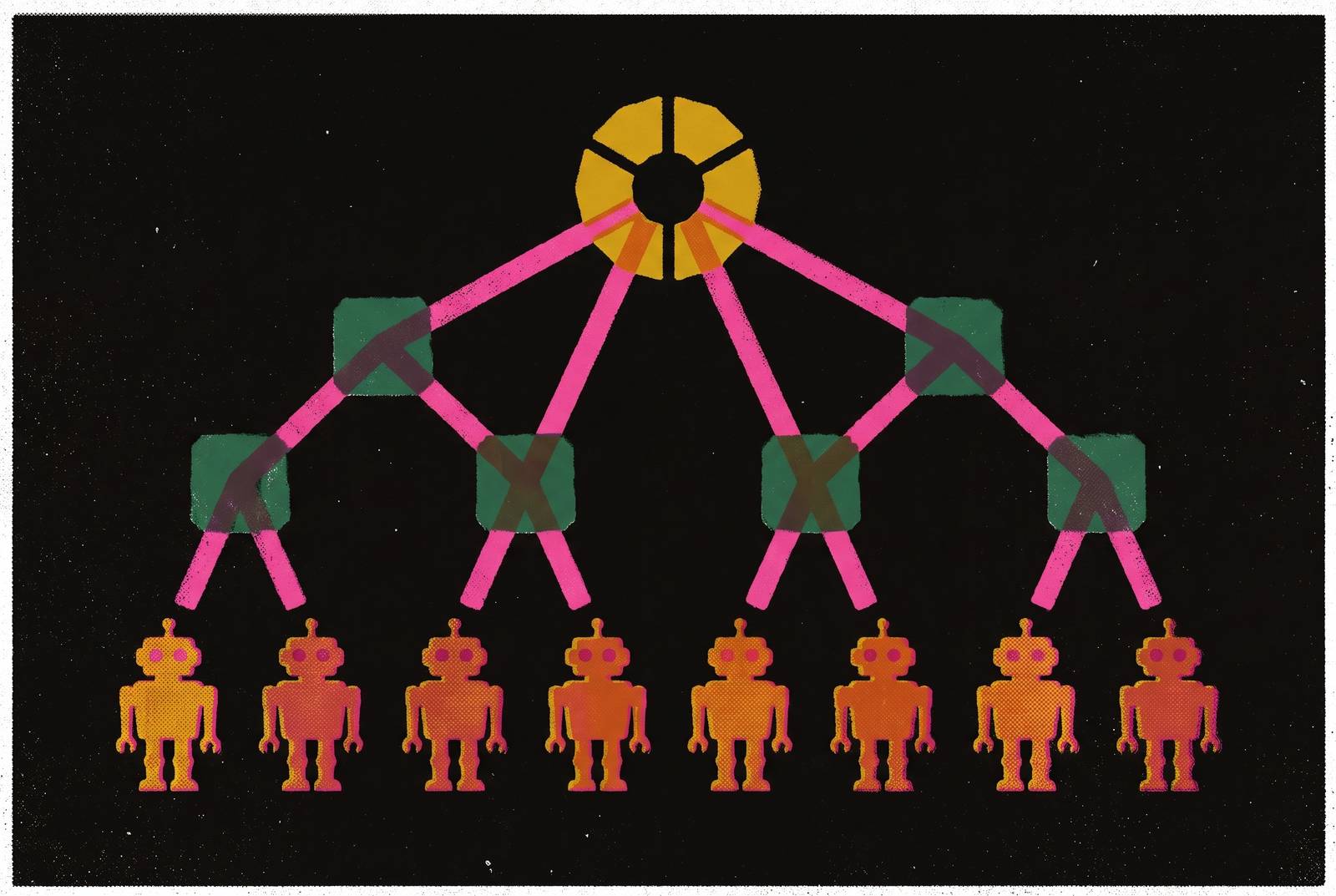
To give company AI agents accurate brand context, teams need a shared, versioned brand dependency in place of a brand prompt they maintain separately for every agent. Every agent must resolve the same authoritative identity rules before it generates output, and the finished work must be checked against that same source.
Why per-agent prompt discipline is the wrong unit of control
A team discovers the structural problem when agents that passed their individual reviews produce inconsistent work after deployment. Each prompt has brand guidance, and each output can be defended as following its own instructions. Yet the customer encounters different interpretations of the same company. Salesforce’s findings from enterprise agent deployments in production showed that getting agents to behave consistently was one of the most common challenges, especially in high-stakes workflows. Teams kept discovering it after go-live.
Rewriting the prompts treats that operational failure as a writing problem. The unit of control is too small. A brand instruction reaches only the agent that receives it, in the form available when its prompt was written. Editing that prompt, adding another agent, or changing the brief creates another opportunity for divergence. Across regions, teams can interpret “conversational” differently without any one interpretation being obviously wrong.
Even when a prompt stays the same, its output can vary because language models are non-deterministic. Nor does an adjective such as “authentic” give a model an explicit constraint it can reliably evaluate. Prose guidelines ask the model to infer rules and then apply them consistently across different tasks. That leaves both the interpretation of the brand and its application unsettled.
What cross-agent context loss looks like in a real fleet
Without shared brand context, an agent pipeline behaves like strangers in a relay race, passing the baton without the understanding needed for the next leg. One agent scores a lead, another drafts outreach, and a third books the meeting. The handoff can pass on the task but lose the positioning constraints and tone rules that should guide it. Each stage then resets to its own interpretation of “on-brand.”
The context window is local and ephemeral. A JSON blob containing lead data does not, by itself, establish a shared brand identity or authoritative rules. Unless those rules are shared state, a successful transfer of data can still be a failed transfer of context. The workflow continues, so the loss need not appear as an operational error.
Across channels, that gap becomes visible to the customer. An ad, a landing page, and a campaign email can each satisfy the prompt of the agent that produced it while contradicting one another in tone or positioning. The fleet therefore cannot be assessed solely as a collection of individually acceptable agents. Its outputs must also agree with the same identity.
How to make brand context automatically available to every agent
Brand context becomes a fleet-wide control when it lives outside individual agents as a dependency they all resolve. A code library provides the structural comparison. It is not retyped into every file that needs it, but declared, versioned, and resolved from an authoritative location. Brand rules need the same separation between the source and its consumers, so changes do not depend on finding and rewriting every embedded copy.
That requires more than relocating a brand guide. The source must be machine-accessible and structured for use. A tone matrix with explicit parameters for different deployment contexts gives agents more precise direction than “be conversational.” Negative constraints that can be checked programmatically do a different job from an open-ended request to avoid corporate language. The stable identity is versioned, while the way it is expressed can change with the channel and the moment.
Role cards extend this separation to each agent’s contract. A versioned, externally readable card defines responsibilities, allowed tools, prohibited actions, expected inputs and outputs, handoff rules, and acceptance criteria. Other agents and operators can then reason about the role without reconstructing it from a private prompt.
MCP as the protocol that makes a shared brand dependency resolvable across agents
MCP gives that external dependency a standard interface. Rather than receiving a copied brand guide at authoring time, a compatible agent queries an authoritative source before generating. An MCP server can expose voice rules, typography rules, color values, positioning constraints, and specific prohibitions. Those rules enter the agent’s context at invocation time, when they are needed.
The integration is not tied to one agent environment. OpenAI, Google DeepMind, Microsoft, and Cloudflare had adopted MCP natively by early 2026, and MCP SDKs reached 97 million monthly downloads by April 2026. With that adoption, agents in many environments can use a shared interface without a separate custom connector for each one. It does not, however, turn the protocol into a complete governance system.
MCP standardizes discovery and invocation. It does not yet standardize identity propagation, adaptive tool budgeting, or structured error semantics at production scale. Teams building on it need to supply those primitives in their governance layer. For products that bring brand context straight into their own stack, a REST API offers another way to reach the same versioned source. The access paths differ, but the authoritative state does not.
Versioning brand context the way code is versioned
A canonical endpoint is insufficient if dependent agents continue using outdated rules. Propagation is part of the dependency contract. A logo update, voice change, or new prohibition must become a versioned change that connected agents pick up, rather than a document revision someone later redistributes. Otherwise, agents that were aligned at deployment can drift as the brand evolves without producing any visible error.
Centralized configuration provides the relevant operational pattern. Production fleet-management frameworks use configuration services to change tools, permissions, and context without redeploying the entire codebase. Brand configuration can follow the same model, with a record of which version the generating agent resolved. That record gives later review an identifiable reference rather than an assumption about what the agent probably knew. It also supports the traceability and transparency associated with frameworks such as the EU AI Act.
LinkedIn’s Brand Kit launch on July 1, 2026, in Campaign Manager illustrates the move toward governed brand inputs. Its AI ad-creative tools use brand colors, fonts, and brand voice as guides. The example establishes brand parameters as configuration, rather than style suggestions confined to an individual prompt. It does not by itself establish the full fleet-wide dependency model, whose additional requirements are propagation and an auditable version history.
How brand review closes the loop the dependency graph opens
Resolving the correct context does not guarantee compliant output. Review closes the loop by evaluating finished work against the same versioned source used at generation time, before it ships. These are complementary controls, with one governing the available context and the other assessing what the agent actually produced.
The peer-review pattern separates drafting, assessment, and disposition. A reviewer scores output against brand guidelines and a “no fabricated specifics” rubric, while a decider ships it, returns it with notes, or escalates it to an operator. The reviewer can be a different, sometimes smaller, model than the drafter. Its role is not to repeat the generation task but to produce evidence against explicit checks.
Bynder’s agents illustrate a production form of brand assessment. They detect and tag logos, including partner brands, recognize brand colors, flag missing branding, and support multi-brand detection. In the shared-dependency model, review results are logged against the version whose rules apply, so an audit can check both that source and each finding. The evidence can also expose weaknesses in the brand rules themselves.
Why multi-brand and agency operators feel this problem most acutely
Agencies and multi-brand operators have more prompts to keep up to date with each brand, agent, and task. Preserving separate identities inside a shared operating environment requires more than keeping instructions current. An agent working for Brand A must not import Brand B’s context, and a shared-prompt approach leaves that boundary dependent on editing discipline.
In the dependency model, each brand has its own versioned source. Colors, fonts, logos, and AI tone guidance are defined once for that brand and follow its relevant agent invocations. This requires three connected layers, including assets, guidelines, and the relationships between them. The asset layer supplies the correct logo version, fonts, and product images, while the other layers explain their use and connections. Without those relationships, operators still have to reconstruct the brand for each job.
Writer represents the enterprise-platform direction toward brand consistency as a system property. Its full-stack AI platform focuses on enterprise content creation and brand consistency and is used by companies including Intuit and Accenture. That is a different emphasis from another vendor’s asset-oriented checks, although both illustrate parts of the broader architecture. For multi-brand operations, the decisive criteria remain separate brand identities, current context, and review against the correct source.
The objection that infrastructure can mask a talent and culture problem
The strongest objection concerns the quality of the identity being distributed. A poorly conceived brand does not improve when every agent follows it consistently. Infrastructure can standardize weak decisions just as effectively as strong ones, spreading an authoring error across the fleet.
That limit deserves a direct acknowledgment. A carefully authored identity layer encodes decisions made by people who understand the brand, allowing those decisions to reach every invocation instead of being reinterpreted by each prompt writer. The layer requires investment in careful authoring, with its quality assessed independently of its structure. Human stewardship remains necessary even when manual redistribution disappears.
What changes when brand context is a graph-enforced invariant rather than a per-agent discipline
Teams keep the authoritative source up to date and check that every relevant agent uses it, instead of searching each prompt for copies of brand guidance that disagree. When output fails review, the investigation can distinguish the context version used from the constraint the output violated. That distinction gives remediation a specific target.
If a tone constraint repeatedly fails review, the evidence can inform a revision in one place that propagates to dependent agents. Reviewers are no longer limited to correcting the same symptom in successive outputs. Their findings become inputs to the infrastructure, while version records preserve the basis on which earlier work was generated and assessed.
Adding an agent then becomes a dependency decision. The new role declares and resolves the relevant brand context instead of requiring another independently maintained interpretation of the identity. For agencies, brand stewardship becomes a configuration and versioning workflow, with output review tied to each brand’s source. Teams maintain the brand layer as infrastructure, with the rules that govern the fleet replacing the copies scattered throughout it as the focus of editorial effort and removing the need to re-thread brand context through every new prompt.